<?xml version="1.0" encoding="utf-8"?><feed xmlns="http://www.w3.org/2005/Atom" ><generator uri="https://jekyllrb.com/" version="3.10.0">Jekyll</generator><link href="https://kellian-cottart.github.io/feed.xml" rel="self" type="application/atom+xml" /><link href="https://kellian-cottart.github.io/" rel="alternate" type="text/html" /><updated>2026-05-29T02:19:53-07:00</updated><id>https://kellian-cottart.github.io/feed.xml</id><title type="html">Kellian Cottart</title><subtitle>Doctoral student in Bayesian AI and Neuromorphic engineering</subtitle><author><name>Kellian Cottart</name><email>kellian.cottart@universite-paris-saclay.fr</email></author><entry><title type="html">Active Continual Learning with Metaplastic Binary Bayesian Neural Networks</title><link href="https://kellian-cottart.github.io/posts/2026/05/bayesian-binary-metaplastic/" rel="alternate" type="text/html" title="Active Continual Learning with Metaplastic Binary Bayesian Neural Networks" /><published>2026-05-29T00:00:00-07:00</published><updated>2026-05-29T00:00:00-07:00</updated><id>https://kellian-cottart.github.io/posts/2026/05/bimu</id><content type="html" xml:base="https://kellian-cottart.github.io/posts/2026/05/bayesian-binary-metaplastic/"><![CDATA[<p>We are excited to share that our paper,  <em>Active Continual Learning with Metaplastic Binary Bayesian Neural Networks</em> , has been accepted as a poster at ICML 2026 in Seoul, South Korea!</p>

<p>This work investigates a major limitation of continual learning systems deployed on embedded and low-power hardware: over time, many models progressively lose the ability to adapt. Parameters become increasingly rigid, uncertainty collapses, and learning slows down until the system effectively stops incorporating new information.</p>

<p>This issue becomes particularly important for edge AI systems operating in changing environments. Robots, embedded sensors, medical devices, and smart cameras cannot rely on large-scale retraining pipelines or cloud infrastructure. They must continue learning directly on-device while remaining computationally efficient.</p>

<h2 id="binary-bayesian-neural-networks-at-the-edge">Binary Bayesian Neural Networks at the Edge</h2>

<p>Binary neural networks are attractive for energy-constrained hardware because they represent weights and activations using only two states, typically $+1$ and $-1$. This drastically reduces memory usage and enables fast bitwise computations compatible with microcontrollers and specialized hardware.</p>

<p>However, efficiency alone is insufficient for real-world deployment. Systems interacting with uncertain environments also require calibrated uncertainty estimates. Bayesian binary neural networks address this by maintaining probability distributions over binary weights instead of deterministic values.</p>

<p>Yet these models exhibit a major issue:</p>

<p>As learning progresses, sign flips become increasingly rare. The posterior distributions gradually collapse toward deterministic states. Eventually, probabilities saturate near $0$ or $1$, uncertainty disappears, and weights become effectively frozen. The network remains efficient, but loses plasticity and adaptability.</p>

<h2 id="bimu-preventing-synaptic-freezing">BiMU: Preventing Synaptic Freezing</h2>

<p>To address this issue, we introduce  <strong>BiMU</strong> , a metaplastic learning rule designed to preserve adaptability in Bayesian binary networks.</p>

<p>BiMU combines Bayesian updates with a controlled forgetting mechanism that prevents the indefinite accumulation of old evidence. Instead of allowing certainty to grow without bound, the method maintains a bounded memory state where outdated information can progressively decay.</p>

<p>Stable knowledge should remain protected, while uncertain or obsolete knowledge should stay easy to modify. This preserves meaningful uncertainty over long learning horizons and prevents the degeneracy typically observed in binary Bayesian models.</p>

<h2 id="active-continual-learning">Active Continual Learning</h2>

<p>Maintaining uncertainty is not only important for stability. It also enables efficient active learning.</p>

<p>Because the model retains calibrated uncertainty estimates, it can dynamically determine when human supervision is actually informative. Instead of requesting labels for every incoming sample, the system selectively queries only uncertain or high-value examples.</p>

<p>In our experiments, this reduced online supervision requirements by up to a factor of $32\times$ while maintaining strong continual learning performance.</p>

<p>This creates an appealing direction for long-lived embedded AI systems capable of:</p>

<ul>
  <li>learning continuously after deployment,</li>
  <li>adapting to changing environments,</li>
  <li>operating under tight energy constraints,</li>
  <li>and minimizing costly human annotations.</li>
</ul>

<h2 id="acknowledgements">Acknowledgements</h2>

<p>This work was conducted with:</p>

<ul>
  <li>Théo Ballet</li>
  <li>Djohan Bonnet</li>
  <li>Damien Querlioz</li>
</ul>

<p>at Centre de Nanosciences et de Nanotechnologies, CNRS, Université Paris-Saclay.</p>

<p>This research is part of the <em>Metaspin</em> project, with connections to PEPR IA and France 2030.</p>

<h2 id="links">Links</h2>

<ul>
  <li>Paper on arXiv: <a href="https://arxiv.org/abs/2605.30198">https://arxiv.org/abs/2605.30198</a></li>
</ul>

<p>We are looking forward to presenting this work in Seoul at ICML 2026.</p>]]></content><author><name>Kellian Cottart</name><email>kellian.cottart@universite-paris-saclay.fr</email></author><category term="Release" /><category term="Machine Learning" /><category term="Bayesian" /><category term="Continual learning" /><category term="Variational Inference" /><summary type="html"><![CDATA[We are excited to share that our paper, Active Continual Learning with Metaplastic Binary Bayesian Neural Networks , has been accepted as a poster at ICML 2026 in Seoul, South Korea!]]></summary></entry><entry><title type="html">A geometrical interpretation of variational methods in machine learning</title><link href="https://kellian-cottart.github.io/posts/2026/05/geometry/" rel="alternate" type="text/html" title="A geometrical interpretation of variational methods in machine learning" /><published>2026-05-04T00:00:00-07:00</published><updated>2026-05-04T00:00:00-07:00</updated><id>https://kellian-cottart.github.io/posts/2026/05/geometry</id><content type="html" xml:base="https://kellian-cottart.github.io/posts/2026/05/geometry/"><![CDATA[<p>
  Variational methods are often introduced through information theory:
  learning means finding an approximate distribution that remains close to a
  target Bayesian posterior. This has a geometrical interpretation. The mathematical object
  being optimized is not a point in a Euclidean parameter space, it's a
  probability distribution living on a curved statistical manifold.
</p>

<p>
  This distinction matters because Euclidean distance between parameters does
  not necessarily measure how much the model changes. Two parameter vectors can
  be far apart in coordinates while inducing nearly identical distributions.
  Conversely, a small parameter perturbation can strongly change the predictive
  behaviour of the model. Variational learning is better understood as
  motion in a space of distributions.
</p>

<h2>The Fisher Information Matrix as a local geometry</h2>

<p>
  Consider a parametric family \(q_{\boldsymbol{\theta}}(\boldsymbol{\omega})\),
  where \(\boldsymbol{\theta}\) parameterizes a distribution over model
  parameters \(\boldsymbol{\omega}\). The space of such distributions can be
  viewed as a Riemannian manifold equipped with the Fisher-Rao metric.
  Infinitesimally, the Kullback-Leibler divergence between two nearby
  distributions behaves like a squared distance [1,2]:
</p>

\[
\mathcal{D}_{\mathrm{KL}}
\big(
q_{\boldsymbol{\theta}}
\,||\,
q_{\boldsymbol{\theta}+d\boldsymbol{\theta}}
\big)
\approx
\frac{1}{2}
d\boldsymbol{\theta}^{\top}
\mathbf{F}(\boldsymbol{\theta})
d\boldsymbol{\theta}.
\]

<p>
  Here, \(\mathbf{F}(\boldsymbol{\theta})\) is the Fisher Information Matrix:
</p>

\[
\mathbf{F}(\boldsymbol{\theta})
=
\mathbb{E}_{q_{\boldsymbol{\theta}}}
\left[
\nabla_{\boldsymbol{\theta}}
\log q_{\boldsymbol{\theta}}(\boldsymbol{\omega})
\nabla_{\boldsymbol{\theta}}
\log q_{\boldsymbol{\theta}}(\boldsymbol{\omega})^{\top}
\right].
\]

<p>
  The Fisher matrix defines the local notion of distance on the statistical
  manifold. It measures how sensitive the induced distribution is to a change in
  coordinates. Large Fisher values indicate directions where small parameter
  changes strongly modify the distribution. Small Fisher values indicate
  directions where the distribution is nearly insensitive to perturbations
  [1,2].
</p>

<h2>Parameter displacement is not distributional change</h2>

<p>
  The Fisher-Rao metric is invariant to reparameterization: it describes the
  geometry of the distribution itself, not the arbitrary coordinates used to
  represent it [2,3].
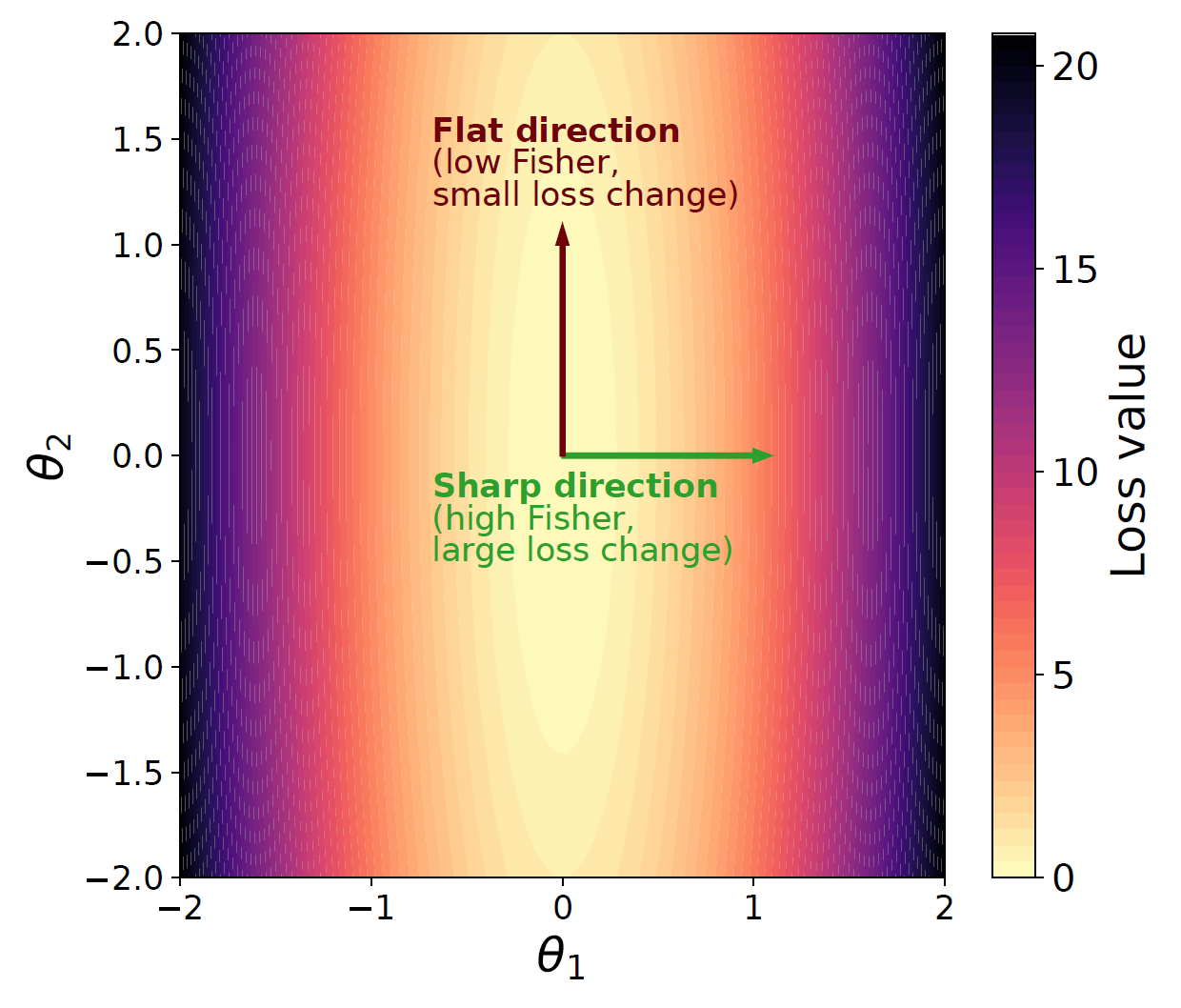
</p>

<figure>
  <img
    src="/images/geometric-variational/loss_landscape.png"
    alt="Anisotropic loss landscape illustrating curvature and parameter importance"
    style="width: 70%; height: auto; margin: auto; display: block;"
    />
  <figcaption>
    <strong>Loss landscape illustrating the link between curvature, Fisher information,
    and parameter importance.</strong>
    The horizontal direction \(\theta_1\) exhibits high curvature: small perturbations
    lead to significant changes in the loss. The vertical direction \(\theta_2\) lies in
    a flatter region, where parameter variations have weaker effect.
  </figcaption>
</figure>

<p>
  The figure illustrates the anisotropic nature of the loss landscape. Some directions are
  stiff: moving along them quickly changes the objective and the predictive
  distribution: this is where the Fisher matrix is large. Other directions are flat: parameters can move without strongly
  affecting the model. The Fisher geometry expands sensitive directions and
  contracts insensitive ones, providing a local measure of
  parameter importance [3].
</p>

<h2>Natural gradients: optimization in distribution space</h2>

<p>
  This geometry changes the meaning of optimization. In ordinary gradient
  descent, the steepest direction is defined with respect to Euclidean distance, with a fixed learning rate.
  In variational inference, the steepest direction is measured with respect to distributional change.
  In this setting, the natural gradient represents the optimal step. It is obtained by minimizing the first-order variation of an
  objective \(\mathcal{L}\) under a local KL constraint [1,2]:
</p>

\[
\min_{d\boldsymbol{\theta}}
\quad
\nabla_{\boldsymbol{\theta}}\mathcal{L}^{\top}
d\boldsymbol{\theta}
\quad
\text{s.t.}
\quad
d\boldsymbol{\theta}^{\top}
\mathbf{F}(\boldsymbol{\theta})
d\boldsymbol{\theta}
\leq
\epsilon.
\]

<p>
  Solving this constrained problem gives the natural-gradient direction:
</p>

\[
\widetilde{\nabla}_{\boldsymbol{\theta}}\mathcal{L}
=
\mathbf{F}^{-1}
\nabla_{\boldsymbol{\theta}}\mathcal{L}.
\]

<p>
  The multiplication by \(\mathbf{F}^{-1}\) corrects the gradient by the local
  curvature of the statistical manifold. Directions that strongly affect the
  distribution are scaled down, while flatter directions can be explored more
  freely [1,2].
</p>

<h2>Bayesian learning as geometrical optimization</h2>

<p>
  The Bayesian Learning Rule frames several optimization and inference algorithms as updates over
  approximate posterior distributions. In this formulation, learning is expressed
  as the minimization of a generalized Bayesian objective, and the resulting
  updates can be written in natural-parameter space using natural gradients. The
  Fisher Information Matrix then appears as the metric that makes the update
  respect the geometry of the posterior family [4].
</p>

<p>
  This is directly connected to continual learning. In methods such as Elastic
  Weight Consolidation, the Fisher Information Matrix is used to estimate how
  important each parameter was for a previously learned task. A parameter with a
  large Fisher value is treated as sensitive: changing it is expected to strongly
  affect the model's previous predictions. EWC adds a quadratic penalty
  that discourages such changes. This protects past knowledge, but it also hinders
  learning by reducing plasticity in directions considered important [5].
</p>

<p>
  Fisher-based continual learning can be interpreted as a geometrical constraint on learning, where the objective
  adapts to incoming data while limiting changes along directions that would strongly modify the model's learned
  distribution. Importance is therefore a measure of how costly a
  parameter perturbation is for the distribution represented by the model
  [1,2,4,5,7].
</p>

<h2>MESU: uncertainty shapes the geometry of continual learning</h2>

<p>
  This connection between Bayesian learning and geometry is a main aspect of
  Metaplasticity from Synaptic Uncertainty (MESU) [6]. In MESU, each parameter is
  represented by a Gaussian distribution whose variance encodes synaptic
  uncertainty. The update rule scales learning by this variance: uncertain
  weights move more easily, while confident weights are stabilized. The posterior
  geometry directly controls the update.
</p>

<p>
  Continual learning becomes a geometrical compromise between three forces. 
  The likelihood term pulls the posterior distribution toward the
  new data. The previous posterior preserves directions that have already been
  constrained by past evidence. The forgetting term relaxes obsolete constraints,
  preventing the model from becoming overconfident and rigid. Learning,
  stability, and forgetting therefore act on the same distributional space:
  learning reshapes the posterior, stability preserves selected directions, and
  forgetting reopens degrees of freedom for future tasks.
</p>

<p>
  The supplementary analysis makes this link explicit through the Hessian. In
  the long-time limit, MESU's synaptic variances become inversely related to the
  diagonal Hessian. High-curvature directions correspond to low variance: the
  model is confident there, and updates are naturally damped. Low-curvature
  directions keep larger variance: the model remains uncertain there, and
  plasticity is preserved. Uncertainty therefore becomes a curvature-aware
  measure of parameter importance.
</p>

<p>
  This places MESU close to Hessian-based regularization methods such as EWC and
  SI, but the mechanism is different. EWC and SI estimate parameter importance
  and impose an external constraint to protect important directions. MESU instead
  lets importance emerge from the posterior. The same quantity that
  expresses uncertainty also modulates plasticity and approximates curvature.
  Stability is not added as a separate penalty; it is induced by the evolving
  geometry of the Bayesian posterior.
</p>

<p>
  The memory window \(N\) controls how much of the past keeps shaping this
  geometry. A large \(N\) retains more past information and strengthens
  consolidation, but it can also collapse variances and reduce plasticity. A
  smaller or finite \(N\) allows older constraints to fade, keeping part of the
  parameter space uncertain and available for new information. This gives MESU a
  direct geometrical interpretation of the stability-plasticity trade-off:
  continual learning depends on how much the posterior manifold is allowed to
  contract around past solutions, and how much it remains open for future ones.
</p>

<p>
  This gives intuition about why Bayesian continual learning without forgetting can fail
  through catastrophic remembering. If all past evidence is accumulated
  indefinitely, the posterior can become too concentrated. The geometry then
  contracts in too many directions: gradients are damped, uncertainty vanishes,
  and the model loses the ability to adapt. 
</p>

<h2>Conclusion</h2>

<p>
  The geometrical interpretation of variational learning provides a unified way
  to understand natural gradients, Bayesian posterior updates, and
  importance-based continual learning. The central object is not the Euclidean
  displacement of parameters, but the distributional change induced by an update.
  Fisher information, Hessian curvature, and posterior uncertainty are different
  ways of describing how sensitive the model is along each direction.
</p>

<h2>References</h2>

<ol>
  <li>
    Shun-ichi Amari,
    <em>Neural Learning in Structured Parameter Spaces — Natural Riemannian Gradient</em>,
    1996, Advances in Neural Information Processing Systems.
  </li>
  <li>
    Shun-ichi Amari,
    <em>Natural Gradient Works Efficiently in Learning</em>,
    1998, Neural Computation.
  </li>
  <li>
    Razvan Pascanu and Yoshua Bengio,
    <em>Revisiting Natural Gradient for Deep Networks</em>,
    2014, International Conference on Learning Representations.
  </li>
  <li>
    Mohammad Emtiyaz Khan and Håvard Rue,
    <em>The Bayesian Learning Rule</em>,
    2023, Journal of Machine Learning Research.
  </li>
  <li>
    James Kirkpatrick et al.,
    <em>Overcoming Catastrophic Forgetting in Neural Networks</em>,
    2017, Proceedings of the National Academy of Sciences.
  </li>
  <li>
    Djohan Bonnet, Kellian Cottart, Tifenn Hirtzlin, Tarcisius Januel,
    Thomas Dalgaty, Elisa Vianello, and Damien Querlioz,
    <em>Bayesian Continual Learning and Forgetting in Neural Networks</em>,
    2025, Nature Communications.
  </li>
  <li>
    Ishan Garg et al.,
    <em>Fisher-Orthogonal Projected Natural Gradient Descent for Continual Learning</em>,
    2026, arXiv preprint.
  </li>
</ol>]]></content><author><name>Kellian Cottart</name><email>kellian.cottart@universite-paris-saclay.fr</email></author><category term="Machine Learning" /><category term="Variational Inference" /><category term="Bayesian" /><category term="Geometry" /><summary type="html"><![CDATA[Variational methods are often introduced through information theory: learning means finding an approximate distribution that remains close to a target Bayesian posterior. This has a geometrical interpretation. The mathematical object being optimized is not a point in a Euclidean parameter space, it's a probability distribution living on a curved statistical manifold.]]></summary></entry><entry><title type="html">Itinérances - Ph.D Student Portrait - Lara Couronné</title><link href="https://kellian-cottart.github.io/posts/2025/12/itinerances/" rel="alternate" type="text/html" title="Itinérances - Ph.D Student Portrait - Lara Couronné" /><published>2025-12-18T00:00:00-08:00</published><updated>2025-12-18T00:00:00-08:00</updated><id>https://kellian-cottart.github.io/posts/2025/12/itinerances-lara</id><content type="html" xml:base="https://kellian-cottart.github.io/posts/2025/12/itinerances/"><![CDATA[<p>
  This portrait celebrates <strong>Lara Couronné</strong>, a brilliant scientist
  whose
  journey blends determination, passion, and creativity. Filmed as part of her daily life in
  research, this video offers a glimpse into who she is, both in and beyond the
  lab.
</p>

<div class="video-container">
  <iframe
    src="https://www.youtube.com/embed/Q1pfILWscow"
    title="Itinérances - Lara Couronné"
    frameborder="0"
    allow="accelerometer; autoplay; clipboard-write; encrypted-media; gyroscope; picture-in-picture"
    allowfullscreen>
  </iframe>
</div>

<h2>A Researcher at the Crossroads of Physics and Quantum Technologies</h2>

<p>
  Lara works under a <strong>CIFRE doctoral contract</strong> between
  <strong>Quandela</strong> and the
  <strong>Centre de Nanosciences et de Nanotechnologies (C2N)</strong>,
  a collaboration where industry and academia converge to push the boundaries of
  quantum technologies.
</p>

<p>
  Her research focuses on <strong>quantum dot entanglement</strong>, a
  cornerstone problem
  in quantum optics and quantum information. Quantum dots, tiny semiconductor
  structures
  that behave like artificial atoms, are promising building blocks for future
  quantum
  devices. Lara investigates how to entangle emitted photons to generate cluster
  states, a fundamental resource for scalable quantum
  technologies.
</p>

<h2>Why It Matters</h2>

<p>
  Entanglement is a key resource in secure communication, quantum computing, or
  advanced sensing. Engineering entangled quantum dot systems is not just a
  theoretical challenge; it opens pathways toward real devices with potential
  impacts across science, industry and new possibilities for Machine Learning.</p>

<p>
  Through meticulous experiment design, precision measurement, and deep
  theoretical
  insight, Lara pushes the boundaries of what we can achieve with quantum dots,
  leading to new computational paradigms.
</p>

<h2>Beyond the Lab</h2>

<p>
  This portrait also captures the human side of research: the curiosity that
  fuels
  long nights of experimentation, the friendships formed along the way,
  the joys and challenges that define life as a scientist, and as a person. How
  science shapes personal mind landscapes and creativity, fueling her passion
  for writing, drawing and painting.
</p>

<p>
  I wished to highlight her portrait through this post, bringing her scientific
  contribution forth to underline the incredible friendship we have built in the
  lab. Our Ph.D. journey became both a scientific and a personal adventure. We
  met unexpectedly, fiercely, pulled by ungraspable gravity. Parts of me that
  were
  long gone revived on that day.
</p>

<p>
  Long discussions, doubts, laughter, intensity, happiest memories, all of it
  shaped who we became as researchers and as people. My life, my research, and
  my journey
  through this Ph.D.
  would not be the same without her presence, and I definitely would not be the
  same without her friendship. I am forever grateful for meeting her, for
  sharing this journey with her, and for all the moments yet to come.
</p>

<blockquote>Thank you for reminding me what being alive feels like, and for
  making me
  love my life.</blockquote>

<style>
.video-container {
  position: relative;
  padding-bottom: 56.25%;
  height: 0;
  overflow: hidden;
  margin: 2em 0;
  border-radius: 8px;
}

.video-container iframe {
  position: absolute;
  top: 0;
  left: 0;
  width: 100%;
  height: 100%;
}

.intro {
  font-size: 1.1em;
  color: #444;
}

.closing {
  margin-top: 2em;
  font-style: italic;
}
</style>]]></content><author><name>Kellian Cottart</name><email>kellian.cottart@universite-paris-saclay.fr</email></author><category term="Interview" /><category term="Personal" /><category term="Quantum Physics" /><summary type="html"><![CDATA[This portrait celebrates Lara Couronné, a brilliant scientist whose journey blends determination, passion, and creativity. Filmed as part of her daily life in research, this video offers a glimpse into who she is, both in and beyond the lab.]]></summary></entry><entry><title type="html">Bayesian Continual Learning in Nature Communications</title><link href="https://kellian-cottart.github.io/posts/2025/10/bayesian-continual-learning/" rel="alternate" type="text/html" title="Bayesian Continual Learning in Nature Communications" /><published>2025-10-30T00:00:00-07:00</published><updated>2025-10-30T00:00:00-07:00</updated><id>https://kellian-cottart.github.io/posts/2025/10/bayesian-cl</id><content type="html" xml:base="https://kellian-cottart.github.io/posts/2025/10/bayesian-continual-learning/"><![CDATA[<p>I’m super happy to announce that Djohan Bonnet, Damien Querlioz and I, as well as co-authors recently published a paper about Bayesian continual learning &amp; forgetting in Neural Networks in Nature Communications! It’s been a long journey to get this paper published and we are very proud of our research.</p>

<p>In this article, we investigate how Bayesian neural networks learn when faced with infinite streams of data, and how non-relevant information is discarded through time thanks to our weight-informed forgetting mechanism based on synaptic importance, circumventing both catastrophic forgetting - when neural networks forget about previous representations - and catastrophic remembering - when neural networks cannot learn anymore -.</p>

<p>Furthermore, we are drawing parallels between plausible neuroscience theories about the brain and machine learning, by finding equivalent update rules for synapses through our mathematical derivation.</p>

<p>We hope to pave the way towards Bayesian-based machine learning on-chip, where memory is limited and large models don’t fit. We are taking steps towards embedded devices generating uncertainties from the random variables representing the synapses, to achieve reliable lifelong learning.</p>

<p>You can find a conference talk taken at the UQ4ML Cometa Workshop at CEA on Youtube: <a href="https://www.youtube.com/watch?v=MAahAo-vwzo&amp;list=PLrLctLPAdPNvUBgvadEthiXlwGpW2cdI9&amp;index=16">COMETA Workshop - Kellian COTTART</a></p>

<p>Check out the open-access paper on the Nature website!</p>

<p><a href="https://www.nature.com/articles/s41467-025-64601-w">Bayesian Continual Learning and Forgetting in Neural Networks - Nature Communications</a></p>]]></content><author><name>Kellian Cottart</name><email>kellian.cottart@universite-paris-saclay.fr</email></author><category term="Release" /><category term="Machine Learning" /><category term="Bayesian" /><category term="Continual learning" /><category term="Variational Inference" /><summary type="html"><![CDATA[I’m super happy to announce that Djohan Bonnet, Damien Querlioz and I, as well as co-authors recently published a paper about Bayesian continual learning &amp; forgetting in Neural Networks in Nature Communications! It’s been a long journey to get this paper published and we are very proud of our research.]]></summary></entry><entry><title type="html">Itinérances - Ph.D Student Portrait - Kellian Cottart</title><link href="https://kellian-cottart.github.io/posts/2024/11/itinerances/" rel="alternate" type="text/html" title="Itinérances - Ph.D Student Portrait - Kellian Cottart" /><published>2024-11-14T00:00:00-08:00</published><updated>2024-11-14T00:00:00-08:00</updated><id>https://kellian-cottart.github.io/posts/2024/11/itinerances</id><content type="html" xml:base="https://kellian-cottart.github.io/posts/2024/11/itinerances/"><![CDATA[<p>
  <em>Itinérances</em> is a portrait of my journey as a Ph.D. student, at the crossroads of
  scientific research, personal passion, and intellectual curiosity.
  This short film explores my daily life in the lab, the motivations that drive my work,
  and the ideas that shape my approach to science.
</p>

<div class="video-container">
  <iframe 
    src="https://www.youtube.com/embed/HyZ99-1wnYQ" 
    title="Itinérances - Kellian Cottart"
    frameborder="0"
    allow="accelerometer; autoplay; clipboard-write; encrypted-media; gyroscope; picture-in-picture"
    allowfullscreen>
  </iframe>
</div>

<h2>Life in the Lab</h2>

<p>
  I am currently a Ph.D. student at <strong>C2N (Centre de Nanosciences et de Nanotechnologies)</strong>,
  in Paris, France. My research takes place at the interface between
  <strong>machine learning, hardware, and neuroscience-inspired computing</strong>.
  The laboratory is a place of experimentation and theory, a space of exploration, doubt, creativity, and persistence. This portrait captures the rhythm of research: long hours of thinking, sudden insights, and the satisfaction
  of progress, often invisible from the outside. A place where collaboration, passion, discovery and unexpected meetings flourish.
</p>

<h2>Research Focus</h2>

<p>
  My work focuses on <strong>neuromorphic computing</strong>, with a particular interest in
  <strong>Bayesian neural network algorithms</strong> deployed directly on hardware.
  I explore how uncertainty-aware learning can be implemented efficiently
  on devices, enabling robust and energy-efficient inference.
</p>

<p>
  In our team, we are targeting advancements in <strong>in-memory computing</strong>,
  where computation is performed where data is stored.
  This paradigm challenges the traditional separation between memory and processing,
  opening new directions for scalable and low-power artificial intelligence systems.
</p>

<h2>Beyond Research</h2>

<p>
  <em>Itinérances</em> is also about what surrounds science:
  the passions that coexist with research,
  the personal drive that sustains long-term commitment,
  and the human dimension behind technical work.
</p>

<p>
  This film reflects my belief that research is a journey: intellectual, emotional, and sometimes uncertain shaped by curiosity and the desire to understand and build.
</p>

<p class="closing">
  I hope this portrait resonates with fellow researchers,
  students, and anyone curious about the life of a Ph.D. student and the world of scientific research.
</p>


<style>
.video-container {
  position: relative;
  padding-bottom: 56.25%;
  height: 0;
  overflow: hidden;
  margin: 2em 0;
  border-radius: 8px;
}

.video-container iframe {
  position: absolute;
  top: 0;
  left: 0;
  width: 100%;
  height: 100%;
}

.intro {
  font-size: 1.1em;
  color: #444;
}

.closing {
  margin-top: 2em;
  font-style: italic;
}
</style>]]></content><author><name>Kellian Cottart</name><email>kellian.cottart@universite-paris-saclay.fr</email></author><category term="Interview" /><category term="Personal" /><category term="Machine Learning" /><summary type="html"><![CDATA[Itinérances is a portrait of my journey as a Ph.D. student, at the crossroads of scientific research, personal passion, and intellectual curiosity. This short film explores my daily life in the lab, the motivations that drive my work, and the ideas that shape my approach to science.]]></summary></entry></feed>